

Two years ago, we packed a big box full of OpenUC2 cubes, lenses and LED arrays and shipped them over to the Eindhoven University of Technology. But why? 50 second-year Biomedical Engineering students had to prepare for the challenge-based learning (CBL) microscopy course where every team had to design, build, calibrate and deploy its own microscope – from scratch. With openUC2 – an easy task!
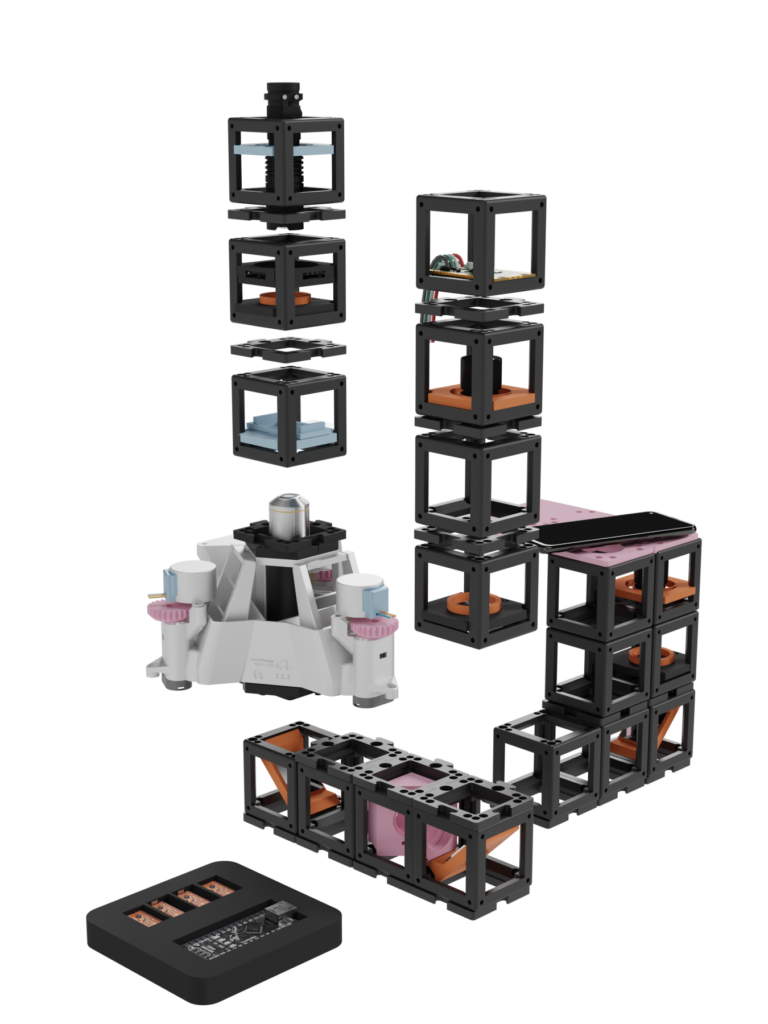
Why UC2 and CBL click
- Modular like LEGO, robust, yet easy to understand lab gear. The UC2 cube toolbox let students snap together bright-field, dark-field, phase-contrast or polarization rigs in minutes, then swap in extras such as Delta stages, half-mirror splitters or ESP32 motor controllers when their ideas grew bolder.
- Real research problems, not cookbook labs. Seven open-ended challenges: from AI-powered histopathology to light-sheet imaging of 3D printed scaffolds. The teams were forced to iterate and improvise, exactly what the microscopes were built for.
What we saw in the la
- Design → Build → Image → Share. Over eight weeks the cohort moved through theory sessions, UC2 workshops, prototyping afternoons, ImageJ introductions and finally a poster pitch day.
- Pretty cool idas: One group mounted twin cameras behind a 50/50 beam-splitting cube for simultaneous bright- and dark-field capture; another coded a Python tiling routine that stitched a whole femur section in high-res while the Delta stage hummed along.
- Instead of learning from books -> learn from experiences! Students calibrated pixel size, NA and mechanical stability, then documented everything in technical reports – exactly the habits we hope UC2 fosters.
Ratings climbed from 8.3 in the pilot years to 9/10 once the course scaled to 50 students, with many calling the “learn-by-doing” format the best way they’d ever tackled optics. From our side, the energy was infectious: questions flew, parts 3D-printed overnight appeared at breakfast, and no cube stayed in one configuration for long. This is now all documented in the freshly published manuscripted available here: https://thebiophysicist.kglmeridian.com/view/journals/biop/aop/article-10.35459-tbp.2024.000287/article-10.35459-tbp.2024.000287.xml
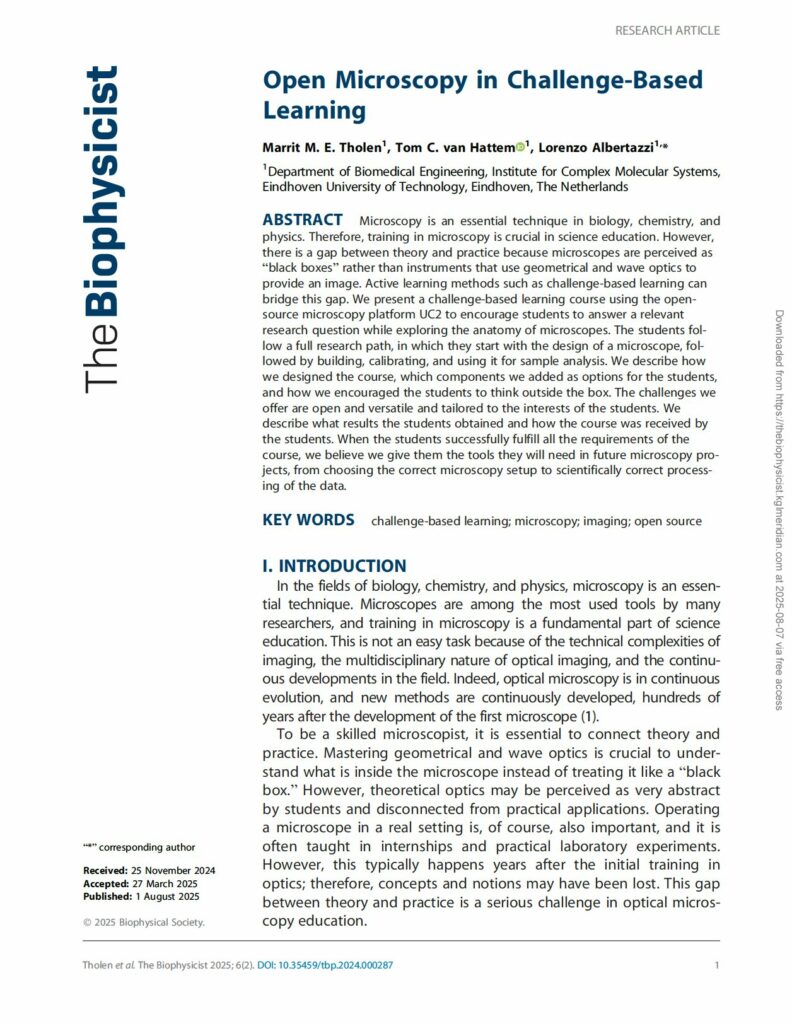
Huge thanks to Marrit Tholen, Lorenzo Albertazzi, Tom van Hattem and the entire TU/e teaching team for testing our open hardware to its limits, and for letting us jump in to troubleshoot focus stacks, swap LED drivers and share a bit of optics enthusiasm. We hope this is only the start! The system has improved with every little bit that went wrong on the way. One thing for example is the online flashing tools: https://youseetoo.github.io/ and the online testing tool of our electronics: ttps://youseetoo.github.io/indexWebSerialTest.html
With this nobody needs to install the Arduino IDE anymore! Yay! 🙂
We’re already have new cubes available ironing out the remaining issues we had last time – so stay tuned! 🙂 If your department is ready to turn lecture halls into makerspaces, join the OpenUC2 community – we’ll bring the cubes, you bring the challenges. Get in touch with us hello@openuc2.com
Stay curious, stay open!